
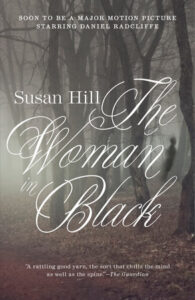
Susan Hill’s 1983 novella, The Woman in Black, stands as a masterful exercise in classic gothic horror. It doesn’t rely on jump scares or gore. Instead, it uses atmosphere, anticipation, and a deep understanding of horror tropes to chill the reader.
By setting the story at the isolated, marshy landscape of Eel Marsh House, Hill purposefully employs several foundational tropes that have defined horror literature for centuries. Here is an exploration of the familiar narrative devices that make this ghost story so unforgettable.
1. The Isolated, Haunted Location: Eel Marsh House
This is the central, most powerful trope in the novel. The vast, decaying house, Eel Marsh House, is physically and symbolically cut off from the rest of the world.
- The Trope: The haunted house or gothic manor—a sprawling, old structure with a dark past, typically in a remote or foreboding environment.
- How Hill Uses It: Eel Marsh House is only accessible via a causeway that is regularly submerged by the tide, rendering it an island of dread. This physical isolation reflects the narrative’s emotional isolation and traps the protagonist, Arthur Kipps, with the spectral entity. The atmosphere of the house (locked rooms, dusty nurseries, and perpetual silence) does the heavy lifting, acting almost as a character itself.
“I had never been in a house which was quite so silent, and quite so cheerless, and quite so utterly devoid of so much as a hint of any warmly human or private life.”
2. The Skeptical, Rational Protagonist: Arthur Kipps
Horror stories often require a character who initially dismisses the supernatural, making the subsequent terror more credible when their reality shatters.
- The Trope: The logical, modern protagonist who enters a situation convinced that all strange happenings have a rational explanation.
- How Hill Uses It: Arthur Kipps, a young, pragmatic solicitor, travels to Crythin Gifford on business. He views sorting out Mrs. Drablow’s papers as a mundane professional duty. His initial reaction to the villagers’ fear is dismissiveness, and when he first sees the Woman in Black, he rationalizes her as an ill or strangely dressed mourner. His gradual descent from professional skepticism to profound terror grounds the supernatural events in a believable, human reaction.
“I did not believe in ghosts. I did not believe in God, either, or in angels, or in the Devil, or in Heaven or Hell. But I did believe in the power of a long-dead soul to curse those who remained behind.”
3. The Unhealed Past and the Vengeful Ghost: Jennet Humfrye
At the heart of any classic ghost story is a trauma that the dead cannot let rest. The ghost is not just an arbitrary spirit; it is a direct consequence of a past injustice.
- The Trope: The vengeful spirit, often a woman who died tragically, whose sorrow or rage keeps her tethered to the earthly plane, usually seeking to punish the living or repeat the circumstances of her own trauma.
- How Hill Uses It: The Woman in Black is the spirit of Jennet Humfrye, who died consumed by grief after her child drowned in the marshes. Her relentless pursuit of vengeance, specifically targeting the children of those who see her, links the past tragedy directly to the present horror. This adds a layer of depth to the terror—it’s not random; it’s a consequence of an unforgivable loss.
“I see her still. She is there. She has only to look at me, and I am reminded of the worst, most fateful day of my life.”
4. The Ominous Warning and the Silence of the Locals: Crythin Gifford’s Secret
The trope of the “outsider” who receives cryptic warnings from fearful locals is a hallmark of Gothic and folk horror.
- The Trope: Villagers or secondary characters who possess knowledge of the darkness but are unwilling or unable to articulate the full horror to the oblivious protagonist.
- How Hill Uses It: The silence and evasiveness of the residents of Crythin Gifford are palpable. From Mr. Jerome, who refuses to stay in the house, to the publican, who quickly changes the subject, the community’s refusal to speak of the Woman in Black serves as a continuous, escalating warning. This creates a powerful atmosphere of dread, suggesting that the horror is so profound it cannot be expressed in words.
“Mr. Jerome had behaved like a man in an agony of fear. That was the only interpretation I could put upon his strangeness.”
5. The Cruel Twist: The “Gotcha!” Ending
While the bulk of the novel relies on atmosphere, the ending employs a famous horror convention: the ultimate, unforgettable final blow.
- The Trope: The narrative structure where the protagonist seems to escape the horror, only to be struck by a final, personal tragedy that proves the ghost’s power is limitless.
- How Hill Uses It: After surviving his ordeal at Eel Marsh House, Kipps returns to London and attempts to build a normal, happy life, marrying and having a child. The final chapter reveals that the Woman in Black made one last, catastrophic appearance, causing a carriage accident that kills his wife and son. This devastating conclusion ensures the story is not merely a ghost tale, but a tragedy, confirming the spectral entity’s power and leaving the reader with a sense of lingering, inescapable doom.
“They asked me for my story. I have told it. Enough.”
By skillfully weaving these classic elements—the haunted house, the rational man, and the vengeful ghost—Susan Hill transforms traditional horror tropes into a modern classic that proves true terror lies not in what we see, but in what we expect, and in the silence of an unhealed wound.
To read more posts about plotting your novel, then click here, or use the links in the sidebar and select How to Plot a Novel.