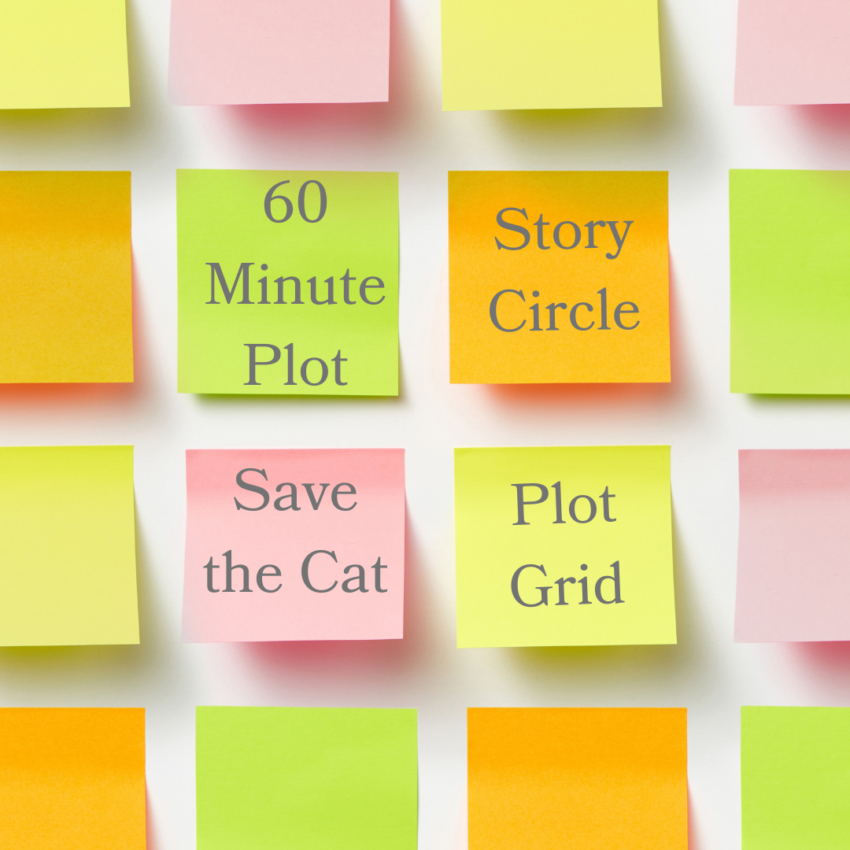
There is one question that every new author and writer asks me. What is the best plotting method for writers? This is a complicated question to answer. Because plotting is a personal process, the best plotting method is the one that will give you what you need when you need it.
In order to determine which plotting method works for you, you first have to determine what type of information you need. Because I need different information at different times, I use a mix of plotting styles, depending on what I need.
| Method | Best For |
| 60-Minute Plot | Fast Brainstorming |
| Story Circle | Character Arcs |
| Plot Grid | Timelines/Subplots |
| Save the Cat | Pacing/Structure |
The 60-Minute Plot (1 Hour Plot)
To get my core plot outline, or if I’m struggling with going down rabbit holes, I use a 60-minute plot method. This method focuses on the core points of the story and leaves me with a basic outline. In theory, it takes an hour to complete – as long as you don’t get sidetracked naming the characters.
While there are many variations of this plotting method, I am unable to find the specific one I use. Because of this, I’m going to include the steps for the exact process I use.
The 60-Minute Plot Step-by-Step
- What matters most to the main character?
List 3 to 5 things to give you the most flexibility when plotting.
- What is the effect when an item is removed?
Losing one of the items creates the inciting incident. It could also raise the stakes. Getting the item back could be the main story goal.
- Why does the character want the item back?
List 3 reasons why they want the item back. If you are struggling to come up with at least 3 reasons, then the goal may not be strong enough to carry the story. This question adds depth to the character’s motivation.
- What are the obstacles to getting the item back?
List at least 6 challenges for the character ranging in severity to maintain the tension. These obstacles form the external plot and create challenges for the character.
- What is the character most afraid of?
List 3 – 5 things that scare the character then choose the one that ties in best with the character’s goal. This is the character arc.
- Why will the character overcome their fear?
List 3-5 reasons they have to overcome their fear. Overcoming this fear is the internal plot. If these reasons are tied into the external plot, then the story will feel less like a lesson.
- List the plot points.
List 10 steps the character needs to take to achieve their goal. Now that we have all the elements, we need to arrange them into a story.
- Add the challenges and twists
Look at each step and write down the worst case scenario for that step.
Examples of the 60-Minute Plot
In order to give an example of how this plotting method works, I used it to break down Suzanne Collin’s Hunger Games.
Dan Harmon’s Story Circle
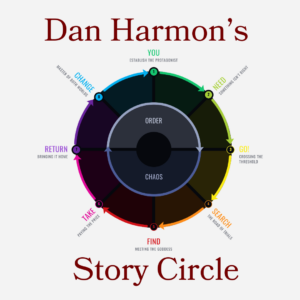
If I need to develop a character arc, then I use Dan Harmon’s Story Circle. The process is a simplified version of Joseph Campbell’s Monomyth plotting method. Instead of doing one for just the main character, I will fill in sections for all the secondary characters to discover their motivations.
Dan Harmon’s Story Circle Step-by-Step
- You. This is the main character’s normal world. As the starting point for the character, this will contrast with the end of the story to show how they changed.
- Need. Although the character is comfortable in their world, they are lacking something. Often this is an internal need, which the external plot will force them to realize.
- Go. The character literally crosses from their everyday world into the world of the story. For example, they may literally move into a fantasy world, or they may simply transition into a setting that differs vastly from their normal one.
- Search. In this step, the character looks for the thing they want and encounters obstacles. For most characters, this is also when they explore their world and learn how it works.
- Find. This is the midpoint of the story. The character believes they have gotten what they were searching for. In reality, this is a false positive.
- Take. Because of the previous step, the character will now pay a heavy price for getting what they wanted. They also have to analyze whether what they wanted is what they needed.
- Return. The character makes their way back to the normal world. This is also when the character acknowledges how they have changed to meet their need in Step 2. If the character has a negative arc, then this is when he intentionally leans into ignoring or abandoning his need.
- Change. Finally, the character now realizes how his life has changed from the journey. This step could also be contrasted with step 1 to show how the character changed.
In order to learn more about Dan Harmon’s Story Circle, I recommend Studio Binder’s video. (I am not affiliated with Studio Binder) To see this plotting method in use, see this post.
Plot Grid
If I need to track a timeline, then I put the information into a Plot Grid. Occasionally, I overlay the Story Circle over the plot grid to determine the pacing of the story points.
Plot grids are often organized by date, chapter, or storyline. However, their flexibility means they can be organized however it works for your process. While this is great for customization, it can also feel overwhelming.
Plot Grid Step-by-Step
Plot Grids are simply a grid that organizes your information. In order to illustrate how to use one, I set up used the common chapter format. To demonstrate this, I made a plot grid of Twilight by Stephanie Meyer.
| Chapter | Bella | Edward | Jacob |
|---|---|---|---|
| 1 | Bella move to Forks, meets Edward, starts a new school, her father gives her a truck | Edward is distracted by Bella. Edward tries to change classes but can’t | Jacob is introduced to Bella, he reminds her that they used to play together as children |
| 2 | Bella settles into school, Bella realizes Mike likes her | Edward is absent from school but returns and is now friendly towards Bella, but mysterious | Jacob is not in this chapter |
For more examples of ways you can organize a Plot Grid, please see this post.
Blake Snyder’s Save the Cat
When I need to develop the story structure, I use Save the Cat Beat Sheets. Blake Snyder created this process for plotting TV scripts. However, Jessica Brody adapted it for novels and it’s one of the most popular novel formats.
Save the Cat Step-by-Step
Save the Cat follows a Three Act Structure. It does not categorize by chapters. It uses the percentage of the overall book instead. This allows the writer the flexibility to have 10 chapters or 30, without and still have a balanced story.
Set-up: Act 1
- 0-1% Opening Image. This is the first impression of your story. It sets the tone, introduces the world, and hints at the story’s themes.
- 5% State the Theme. Early on, a character (often unknowingly) states the central theme of the story. This might be a question or statement that resonates throughout the narrative.
- 1-10% The Setup. Introduce your protagonist, their world, and their current situation. Establish their routine, desires, and potential conflicts.
- 10% The Catalyst. Also known as the inciting incident, the catalyst is an event or incident that disrupts the protagonist’s life, forcing them to react and setting the story in motion.
- 10-20% The Debate. The protagonist hesitates or questions whether to take on the challenge presented by the catalyst. This internal conflict adds depth and realism.
- 20% Break Into 2. The protagonist decides and crosses a threshold, committing to the new path or adventure. There’s usually no turning back.
Confrontation: Act 2
- 22% The B Story. This is the introduction of a subplot or secondary storyline, often involving a love interest or a supporting character. This adds depth and complexity.
- 20-50% Fun & Games. This is the heart of the story, where the protagonist faces challenges, explores the new world, and experiences both successes and setbacks.
- 50% The Midpoint. A significant turning point occurs, often raising the stakes or revealing new information. The protagonist may experience a victory or a major setback.
- 50-75% The Bad Guys Close In. The antagonist or opposing forces gain momentum. The protagonist faces increasing pressure and challenges.
- 75% All is Lost. The protagonist reaches their lowest point. Their plans fail, their hope dwindles, and everything seems lost.
- 75-80% Dark Night of the Soul. The protagonist reflects on their journey, confronts their flaws, and experiences a moment of self-doubt and despair.
- 80% Break into 3. The protagonist finds renewed strength, often through a realization, a memory, or the support of others. They devise a new plan.
Resolution: Act 3
- 80-99% Finale. The protagonist confronts the antagonist or the central conflict in a final showdown. This is the climax of the story.
- 99-100% Final Image. The story concludes with a lasting image that reflects the protagonist’s transformation and the resolution of the story’s themes.
In order to find out more about Save the Cat, check out Studio Binder’s video. (I am not affiliated with Studio Binder)
Other Plotting Methods
I will occasionally dabble with other plotting methods. I might use 4 corner opposition to help me develop conflicts between characters. In my early writing, I would combine a 7-Point Structure with Gwen Haye’s Romancing the Beat.
There are still more plotting methods. The Snowflake Method is popular with authors who want a more organic flow. The process starts with one sentence and adds more detail with each step. Kishōtenketsu, is a 4-act story structure that is popular in Asian work.
Which Method to Choose
The real trick to finding the perfect plotting method is to try out different ones until you find what works for you. My advice is to ask yourself what exactly you want to have at the end of the process. If you’re a pantser and want a few story points to keep you on track, then something like the 60-Minute Plot might work. If you are a plotter, then you’ll want to try something that will give a more detailed outline like Save the Cat or Romancing the Beat.
In the end, you may find that a mix of different plotting methods, or one you make up on your own, works best for you.