

Successful authors understand one important fact that many unsuccessful ones don’t. Writing is a business. Over the years, I’ve owned a retail computer store, a commercial photography business, and currently, I’m a story coach and author. While these businesses are very different, the actual business concepts remain the same. This is something that many authors struggle with, so here are a few tips to help you manage your writing business.
Writing is your business
Your writing is your business. This is your job. Until you view it as a serious business venture, it will always remain in the realm of a hobby. It’s hard to think of writing a few words on a page as work. But if you aren’t taking it seriously, then why should anyone else?
Organize like a business
Because writing is your work, it needs to be treated as such. On your calendar, block out dedicated work hours. This can be a sizeable chunk of time or broken up into dedicated task slots. During these times, don’t answer the phone unless it’s a business call. Don’t schedule other appointments unless they directly relate to your business.
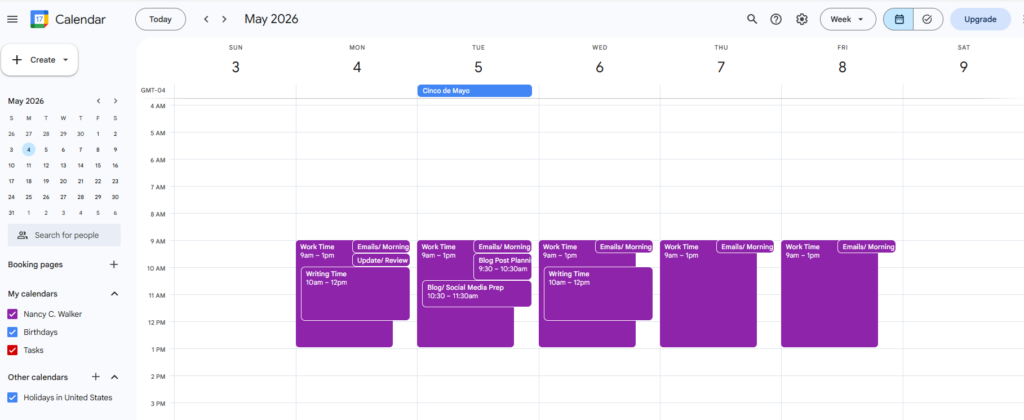
If you do not have a single large chunk of time available for your business, then break the tasks into smaller chunks and spread them out. The trick is to create a consistent time and/or day that you will dedicate to your business.
Do you need to register?
Each state and country has its own rules about when or if a self-published author is required to register as a business. I am not a lawyer or an accountant. If you need advice about your specific situation, you should seek out someone who specializes in business formation.
Registering your business allows you to open a bank account in the name of your company instead of your personal name. It also prevents anyone else from registering under the same name, which can cause confusion later.
For more about the different business entities, check out Mike Kowis, Esq.’s article on the Nonfiction Author’s Association website.
Tip: Registering with the IRS gives you a free EIN number. Use the EIN instead of your social security number on W-9 forms to protect your privacy.
Separate your finances
When you’re only seeing a few dollars a month from self-published royalties, it may seem pointless to go through the hassle of setting up a separate bank account. However, it’s one of the easiest ways to track your expenses, income, and deductions when tax season comes around.
Tracking finances seems daunting, but it doesn’t have to be. There are programs like Quickbooks that you can invest in. If you aren’t ready to spend money on Quickbooks, then you can use a program like Excel. I used Google Sheets for years to track my business’s finances. Tracking your costs becomes even more important when you are getting ready to publish your book and need to make sure you have enough funds to pay the editor, cover designer, and the copyright office.
Business contact information
As an author, you might take your laptop to the library or a coffee shop to work on your novel. But this isn’t where agents and fans are going to send your mail. If you don’t have a business address, then they are sending everything to your home.
PO Boxes
A post office box is an inexpensive way to have an address you can use without revealing your personal home address. If you don’t want a PO Box, there are companies that offer a PO Box-type service, often for a reasonable price.
Tip: Use this address on any documents that may be available to the public. For example, the address on your copyright documents is publicly available.
A word about emails
You may already have an email address, but do you really want a podcaster emailing hotmomma69@fakeemail.com for an interview? This does not mean you have to buy a me@myname.com email. There are several free email services available, like Google, that you can use to create a more professional-sounding email address. The bonus to using a service like Google is that it often comes with storage options for other documents.
Inventory Management
When most people think of inventory, their first thought is a warehouse with stacks of boxes or books. While some authors do sell out of their homes or via a website, this is only one type of inventory that authors need to manage.
Physical inventory
If you sell physical copies of your book from your home, then you will need some way to track how many copies you have in stock, who purchased them, where they need to be sent, and if the buyer’s payment cleared. If you are getting into this level of sales, then I recommend finding a software program that will help you track this information because now you are getting into the realm of a retail storefront, which can be complicated even if your business and personal finances are separate.
Digital inventory
An author’s digital inventory includes everything from book project details, or book Bibles, to brand details, to tracking which agents received which manuscript. This sounds overwhelming until it’s broken down into simple steps.
First, understand that not everything has to be set up at once. If you are writing your first book, then you don’t need to track manuscript submissions yet. Start at the beginning and then create the tracking as you need it. It’s like when you’re writing a mystery. Don’t drop all the clues in the first chapter. Instead, you wait and reveal them when you need them.
You can use whatever system works for you, but here’s how I set up mine.
I create a topic folder on my computer or in cloud storage. In my book folder, each book has its own sub-folder where I keep my character notes, plotting structures, and drafts. The agents folder has a spreadsheet listing agents that might be interested in my work, with their public contact info, genres, and other details. The submissions folder has a spreadsheet tracking manuscripts and where I sent them for consideration.
Regardless of your setup, back up all of your data in multiple locations.
Conclusion
Your writing is your business. If you don’t take it seriously, why will anyone else?
For more writing advice, click here.