
We can’t talk about character development in mystery stories without discussing the two most popular detectives in the world: Sherlock Holmes and Hercule Poirot. They are the literary men who defined the detective genre. Their stories set the foundation for classic mystery stories and give them a level of fame that most literary characters never achieve. Guinness World Records named Sherlock Holmes as the most portrayed human literary character in film and TV in 2012. Hercule Poirot is the only literary character to have his obituary published in the New York Times.
Yet, as writers, analyzing Holmes and Poirot reveals an incredible lesson in character development. While amateur character craft often relies on shallow quirks, Arthur Conan Doyle and Agatha Christie built their legendary detectives by anchoring their methods directly into Holmes’s and Poirot’s unique cultural backgrounds and personal worldviews.
Establishing the Standard: More Than Just Quirks

It is easy to look at these characters and see a bundle of eccentricities. We picture Holmes with his deerstalker hat and violin, and Poirot with his immaculate, perfectly waxed mustache. But iconic character development requires an equal standard of depth. Their physical presentation is not just window dressing because it reflects how they process the world.
Holmes’s chaotic, bohemian lifestyle at 221B Baker Street is a direct byproduct of his hyper-focused mind. Because he only values order when it applies to data, he completely ignores domestic neatness. As a result, his rooms are famously cluttered with chemical experiments, unanswered mail pinned to the mantelpiece, and tobacco stored in a slipper.
Conversely, Poirot’s intense obsession with symmetry, order, and method is his core philosophy rather than a comedic trait. For Poirot, a crooked picture frame or an unevenly cut piece of toast represents a disruption of harmony. He believes that crime is the ultimate disruption of social order, and his job is to restore that symmetry.
The Method: Late-Victorian Forensics vs. Post-WWI Psychology
The most profound contrast between the two lies in their investigative DNA. They challenge the default detective archetype in entirely opposite ways.
Sherlock Holmes: The Empirical Observer
Holmes is the quintessential product of the late-Victorian scientific boom. His world is governed by rigid facts, chemistry, and physical data. He tackles a crime scene with a literal magnifying glass to hunt for the specific origin of a mud splatter, the unique ash of a Trichinopoly cigar, or individual boot prints. He works from the outside in because he believes that the physical world holds an objective truth that cannot lie.
Hercule Poirot: The Psychological Interrogator
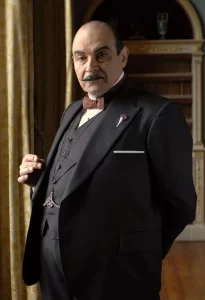
Christie introduces Poirot decades later, and he rejects Holmes’s forensic obsession. He actively mocks the idea of kneeling on the floor to look for cigarette ash. Poirot knows physical clues can be faked, hidden, or misinterpreted. Instead, his laboratory is the human psyche.
Poirot relies on his little grey cells. His method is deceptively simple because he just sits back, creates a comfortable environment, and lets people talk. He understands human beings are driven by ego, fear, and habit. By analyzing the gaps between how people want to be perceived and how they actually behave, the truth inevitably surfaces.
Deconstructing Bias: Cultural Context as a Character Lens
When creating distinct characters, the setting and social context act as vital lenses. Neither Holmes nor Poirot exists in a vacuum, and their backgrounds dictate how they interact with the law and authority.
Sherlock Holmes: The Imperial Insider
As an Englishman operating at the height of the British Empire, Holmes has an innate, quiet confidence in his position. He works alongside Scotland Yard, but he frequently steps outside the rigid boundaries of the law. If he believes a criminal’s motives were justified, or if official justice would cause more harm than good, Holmes will quietly let them go. He answers to his own internal compass of British fair play.
Hercule Poirot: The Displaced Outsider
Poirot enters British fiction as a Belgian war refugee. He is an outsider to English society; a status Christie brilliantly uses. Because the insular British upper class often underestimates a short, fastidious foreigner with a heavy accent, they let their guard down around him. Unlike Holmes, Poirot has a much more rigid view of societal order. Having seen his own homeland disrupted by war, he views murder as a profound moral stain on civilization that the truth must systematically cleanse.
Where the Titans Meet
Despite their vast differences in method and temperament, Holmes and Poirot share the same structural skeleton that makes a legendary protagonist work:
- The Loyalty of the Companion: Both require an anchor. Dr. Watson and Captain Hastings are not just there to ask questions; they provide the emotional center and the moral sounding board that keeps these highly intelligent men tethered to humanity.
- Absolute Intellectual Authority: Both possess a supreme, borderline arrogant confidence in their own minds. They tolerate the official police forces with a mix of amusement and impatience, knowing the authorities are trapped by conventional thinking.
- An Unwavering Pursuit of Truth: Beneath Holmes’s cold logic and Poirot’s theatrical vanity beats the heart of a deeply moral protector.
The Writer’s Takeaway
When you sit down to write your own cast of characters, remember character development is more than a trait like being messy because it sounds interesting. Tie that trait directly to how they solve problems, how they view their society, and how they protect the people around them.
And remember, they never would have been able to do any of it without Edgar Allan Poe.
Are you looking for more articles about writing? Check out the Writing Advice Category.