
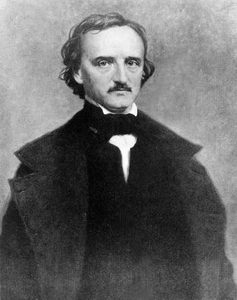
Edgar Allan Poe created the foundations of detective fiction when Graham’s Lady’s and Gentleman’s Magazine published his story, “The Murders in the Rue Morgue”, in April 1841. Before that time, crime in literature relied almost entirely on Gothic terror, sensationalized violence, or moralizing fables. Stories focused on the crime itself, or the divine retribution that followed, rather than the intellectual process of unraveling the mystery. Poe completely inverted this dynamic. He shifted the focus away from the gruesome act and focused on the mental agility required to solve it. Poe referred to this pioneering narrative technique as ratiocination.
This pivot from visceral horror to pure intellect laid the groundwork for an entirely new literary architecture. Guided by his brilliant, eccentric sleuth, C. Auguste Dupin, Poe did far more than write a compelling tale. Over the course of three short stories, he established the core tenets of ratiocination that mystery writers still rely on today:
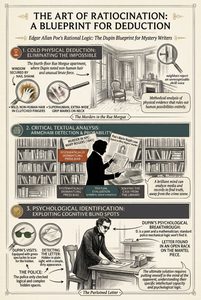
Cold Physical Deduction: Eliminating the Impossible
The first pillar of ratiocination requires replacing emotional panic with relentless physical analysis. When faced with a perplexing crime scene, an investigator must evaluate physical evidence without bias. They must methodically rule out impossible scenarios until only the truth remains, no matter how extraordinary.
Poe demonstrates this principle in “The Murders in the Rue Morgue” (1841). In a fourth-floor Paris apartment, two women are brutally slaughtered. They are found behind doors locked from the inside and windows secured by heavy iron nails. While the official police arrest an innocent man out of sheer confusion, Dupin focuses on physical mechanics. He discovers a window held by a hidden spring with a broken nail shank. This reveals how the killer escaped while preserving the illusion of a sealed room. Dupin pairs this structural breakthrough with minute trace evidence:
- Incomprehensible Speech: Neighbors heard a shrill voice that no European speaker could identify, hinting at a non-human origin.
- Non-Human Hair: Dupin recovers a tuft of tawny hair from the victim’s clutched fingers that matches no human profile.
- Superhuman Strength: Dark, broad bruises on the throat indicate a grip far wider than any human hand could exert.
By calculating these physical parameters, Dupin concludes that the killer is an escaped Bornese Ourang-Outang (Orangutan). Poe also introduced the archetypal of the Ineffective Police Force. He demonstrates this through the Prefect G of the Parisian Police. Dupin famously mocks Prefect G as being “somewhat too cunning to be profound.”
Critical Textual Analysis: Armchair Detection and Probability
Ratiocination does not always require stepping foot inside a physical crime scene. The second pillar relies on pure data analysis, media literacy, and mathematical probability. This proves that a sharp mind can parse truth from conflicting information purely through textual evaluation.
In “The Mystery of Marie Rogêt” (1842), Poe puts this methodology to the test by pioneering armchair detection. Poe bases the story on the real, highly publicized 1841 murder of Mary Cecilia Rogers in New York City. He changes Mary’s name to Marie Rogêt and the setting to Paris. Then he sets Dupin to work solving the case entirely from his library by analyzing newspaper reports. He then has Dupin systematically dismantle the biases, sensationalized theories, and lazy logic of the local press. Instead Poe had Dupin rely purely on textual analysis and probability.
Attempting to solve an active, real-world murder in real time introduced an unprecedented narrative challenge. During serialization, an innkeeper made a deathbed confession revealing that Mary Rogers had actually died during a botched medical procedure. Because this contradicted Poe’s initial fictional theory, he frantically made last-minute revisions to align the last installment with the news, later adding footnotes claiming his analysis had anticipated the outcome all along. Despite these real-world narrative adjustments, Poe proved an investigator can solve a crime through critical data evaluation alone.
Psychological Identification: Exploiting Cognitive Blind Spots
The third and most sophisticated pillar of ratiocination moves beyond physical clues and newspaper text into the realm of psychology. True ratiocination requires the sleuth to project themselves into the mind of their opponent, understanding the culprit’s specific intellectual capabilities to anticipate where and how a clue will be hidden.
Poe showcases this psychological battle of wits in “The Purloined Letter” (1844). An unprincipled political figure, Minister D., steals a compromising letter from the Queen’s boudoir in her full view. For three months, the police secretly searched the Minister’s residence using microscopes and needles to inspect chair legs, floorboards, cushions, and hollow spaces, but found nothing. Poe uses their failure to illustrate a fatal flaw in standard investigative logic: the police assume that because the letter is immensely important, it must be hidden in an immensely complex, concealed location.
Dupin realizes Minister D. is both a mathematician and a poet, making him capable of anticipating standard police methods. Putting himself in the mind of his opponent, Dupin deduces the Minister would hide the letter in plain sight, the most obvious place possible, to avoid suspicion. Equipped with dark spectacles to scan the room undetected, Dupin visits the Minister and immediately spots the dirty, crumpled letter stuffed carelessly into a card-rack hanging over the mantelpiece. By swapping the letter with a decoy, Dupin solves the case through psychological insight rather than physical search tools, proving that the best way to obscure a secret is to exploit the cognitive blind spots of those looking for it.
The Narrative Engine
Poe also realized that a brilliant puzzle needs the right narrative vessel. He introduced the observational narrator, the loyal companion who asks the questions the reader is thinking, and endowed his sleuth with a dual nature that combined mathematical logic with poetic intuition.
When Sir Arthur Conan Doyle introduced Sherlock Holmes in 1887, he openly acknowledged this debt by having Dr. Watson compare Holmes directly to Dupin. Though Holmes dismissively sneered that Dupin was merely “a very inferior fellow,” he proved the opposite seconds later by performing a mental deduction demonstration pulled straight from Poe’s playbook. Holmes’s outward arrogance could not disguise his structural lineage. From Hercule Poirot’s quiet logic to the high-tech forensic unravelings of modern procedural dramas, every great sleuth who followed still operates within the narrative architecture Edgar Allan Poe constructed in 1841.
Applying the Foundations of Detective Fiction
When plotting your own mystery narratives, Poe’s legacy offers a simple lesson: the structure of your investigation must directly match the nature of your puzzle. Whether you are guiding your sleuth through cold physical deduction, media and text analysis, or psychological identification, the true engine of a mystery is not the shock of the crime. It is the satisfying geometry of the solution.
For more on what mystery writers can teach us, check out Holmes v. Poirot: Character Development Lessons from the Masters of Mystery.